

Dynamic Real Water
Complete ocean simulation framework, GPU FFT waves, per-shape buoyancy physics, drivable vessels with multiplayer replication, and dynamic water interactions.
Overview
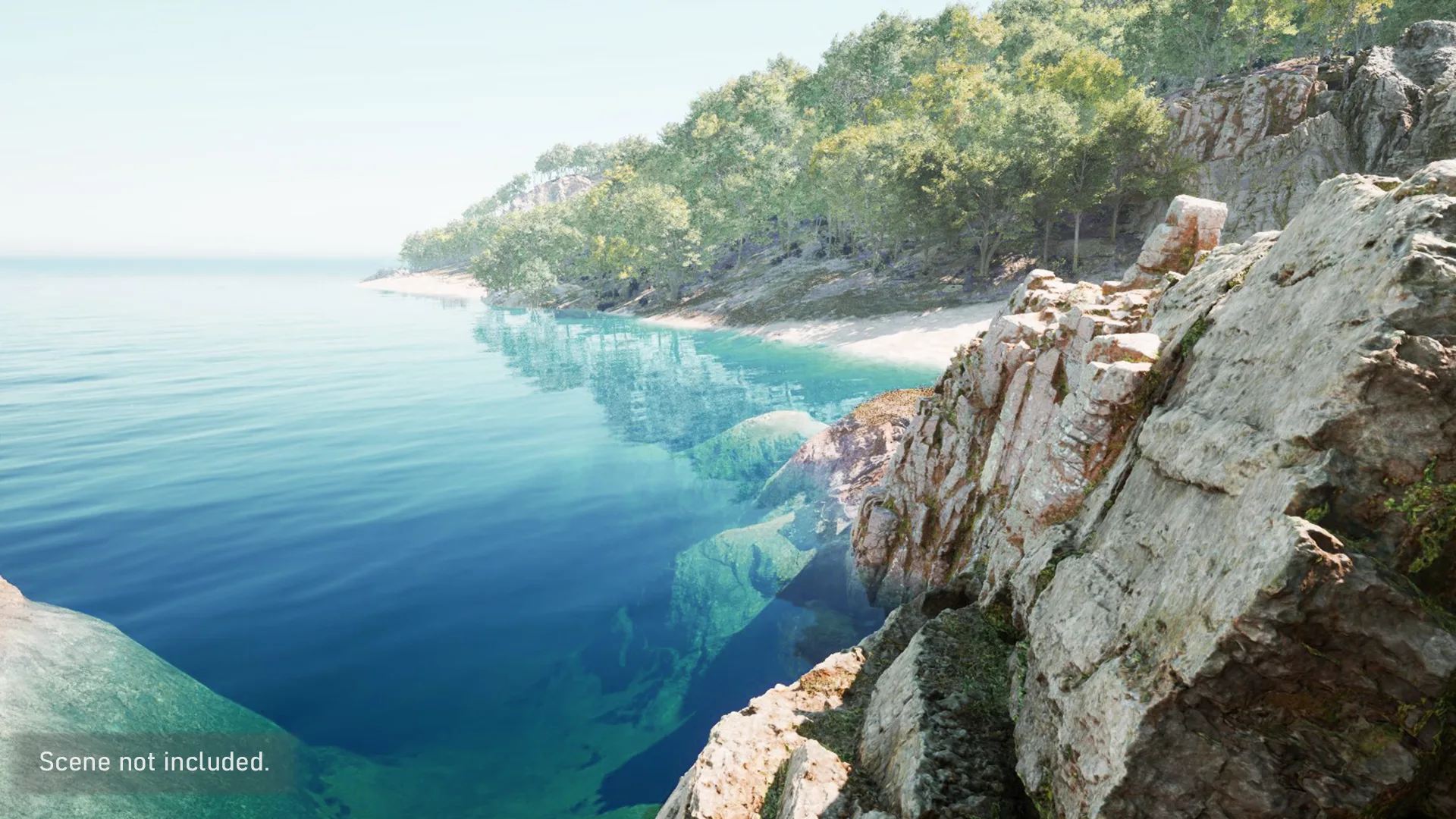
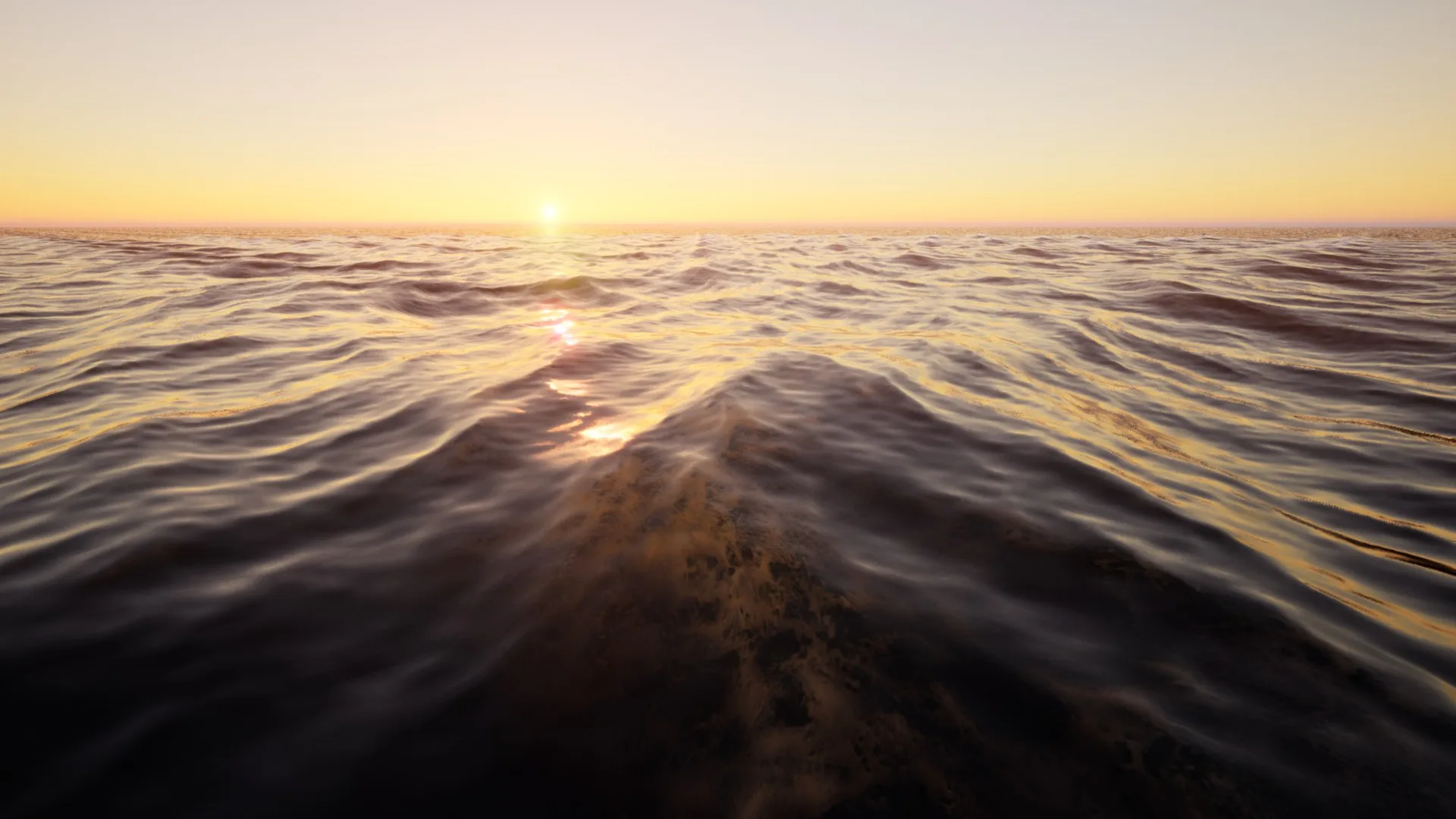
Section titled “Overview”Dynamic Real Water (DRW) is a high-performance, fully modular AAA quality C++ plugin for Unreal Engine 5, built to empower technical artists and developers with a physically accurate, realistic, and deeply customizable water system for AAA games. Designed with performance and scalability in mind, DRW integrates compute shader–based FFT wave simulation, LOD-aware grid streaming, depth-aware rendering, and asynchronous physics into a single, unified system, giving you full creative control over water behavior, appearance, and interaction.
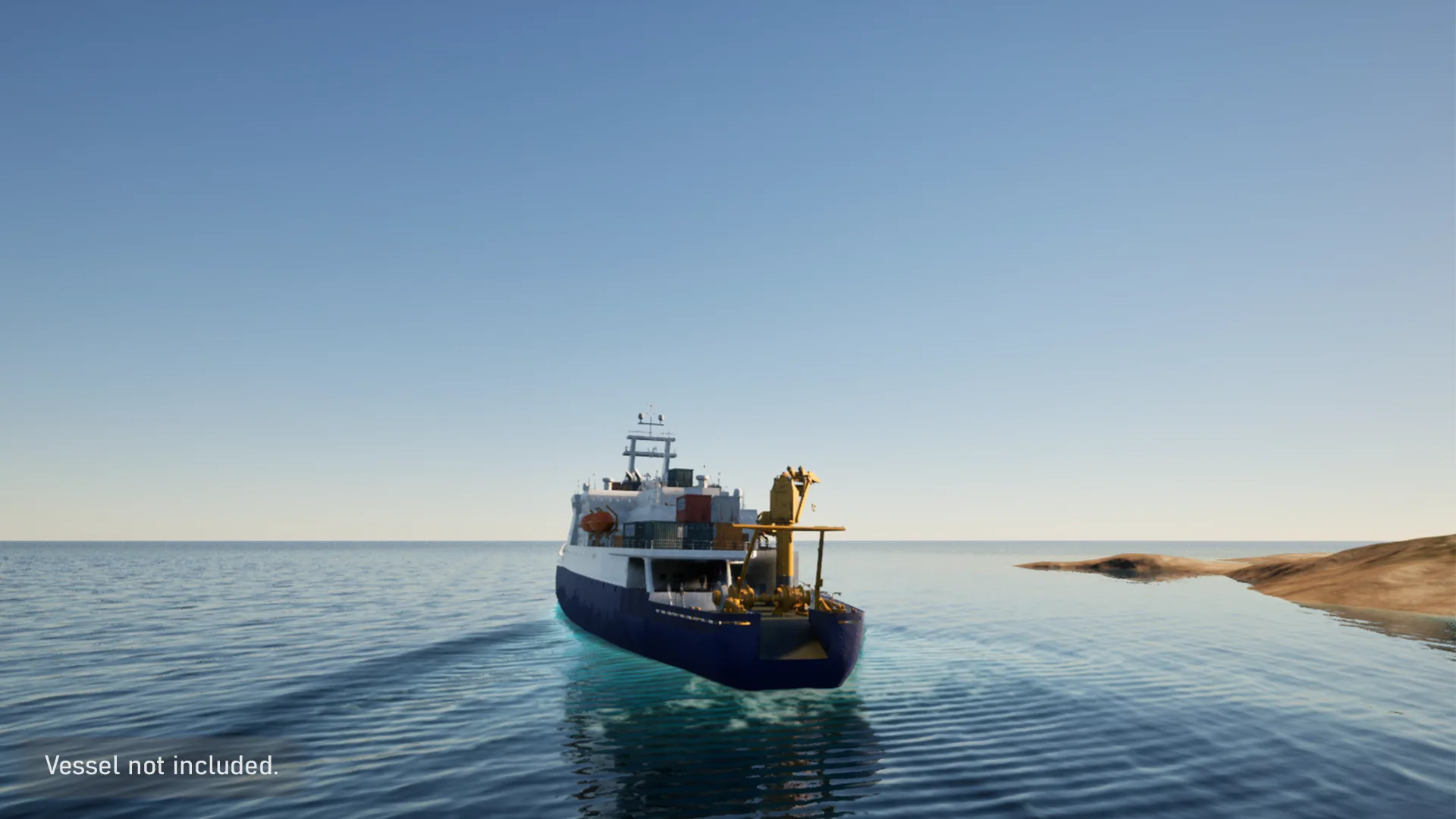
The research vessel pictured in the screenshots is based on the Fab product Research Ship and is not included with Dynamic Real Water.
Why is DRW different from other assets?
Section titled “Why is DRW different from other assets?”Dynamic Real Water (DRW) is a comprehensive ocean and physics simulation module for Unreal Engine 5. Buoyancy and vessels are full physics simulations, not animated approximations. The plugin ships with the following features:
- GPU-accelerated spectral wave generation using FFT.
- Energy-preserving wave blending across Phillips, Pierson-Moskowitz, and JONSWAP spectra.
- Runtime preset blending with easing curves and ready-state delegates.
- Massive 256 × 256-tile coverage (approximately 16 km / 10 mi).
- Dynamically customizable advanced grid management.
- Discrete water bodies (pools and lakes) with per-body visuals and automatic buoyancy transitions.
- Real-time specular lighting.
- Physically based foam pipeline driven by Jacobian wave data.
- Physically based caustics with chromatic aberration and interaction-coupled distortion.
- Real-time water interaction layer for ripples, wakes, splashes, and physics coupling.
- Dynamically responsive underwater system.
- Async waterline system.
- Per-actor water surface and buoyancy masking via SurfaceMaskComponent.
- Custom physics body system with additive/subtractive collision shapes.
- Physically accurate buoyancy simulation with per-shape force calculations.
- Wake-driven coupling between floating actors, so a vessel’s wake pushes nearby objects.
- Skeletal Mesh buoyancy.
- Smooth landscape depth-map generation.
- Modular vessel simulation with five hull types, four movement regimes, and four seat types.
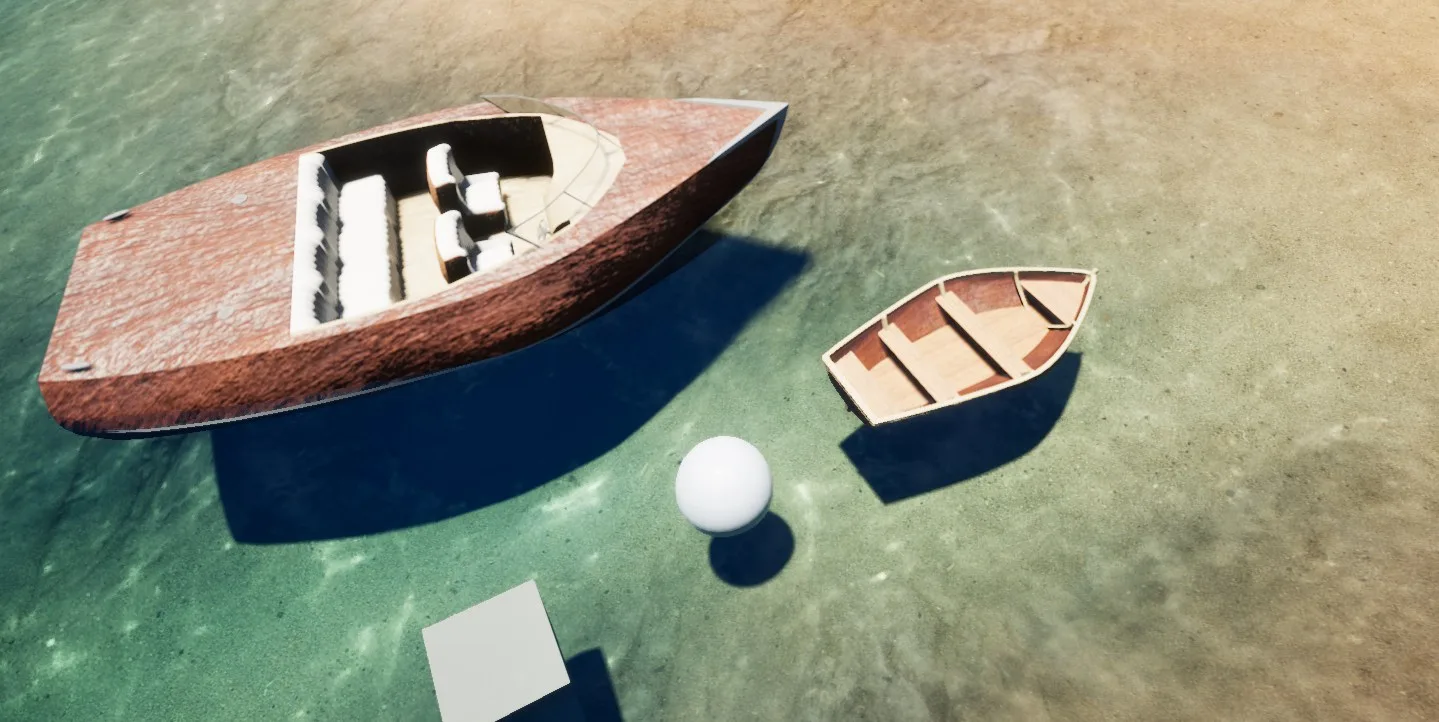
- Three shipped reference vessels (Dinghy, Runabout, TallShip).
- Vessel-attached camera with horizon stabilization, speed-based FOV, and world collision.
- Enhanced Input vessel input with quantized analog replication.
- Niagara-driven spray system for strong wave impacts and object interactions (Experimental).
- Full multiplayer support across waves, buoyancy, vessels, water interactions, and underwater effects, with no extra wiring.
- Fixed-timestep buoyancy with configurable calculation rate (1–120 Hz) to match replication.
- Client-side smooth replication for networked transforms without altering the authoritative simulation.
- Replicated underwater masking.
- Simple, drag-and-drop system.
- Fully data-driven configuration through Data Assets for every tunable surface.
- Modular actor setup.
- BP_Drone default control pawn with built-in vessel possession and seat occupation.
- Sequencer support.
- One-node Blueprint Library for water-state queries and runtime control.
- Categorized debug subsystem for force, velocity, and shape visualization.
- Asynchronous GPU read-back.
- Asynchronous task subsystem with distance prioritization and low-priority starvation prevention.
- Multi-instance buoyant actor optimization for crowded scenes.
- High quality optimization (Costs 2.7 ms on 3060ti in the editor).
- Physically based AAA quality water.
- A roadmap that will be continuously developed.
Documentation
Section titled “Documentation”Get started
- Your first vessel in 10 minutes: linear walkthrough using only shipped content
- Quick Start: five recipes for the major systems
Concepts (the why and when)
- Choosing a wave spectrum: Phillips, PM, JONSWAP
- Discrete water bodies vs ocean: when each system fits
- Possession vs seat occupation: vehicle-style vs character-style control
- Hull state and movement regimes: Displacement, Transition, Planing, Foiling
- Physics quality modes: Async / Mixed / Runtime
- Multiplayer model: what’s authoritative, what’s predicted
Guides (the how)
- Approximating a hull with physics shapes: the highest-skill workflow in the plugin
- Bringing your own boat mesh into a VesselPawn
- Tuning a planing hull
- Multiplayer setup checklist
Reference (the what)
- Actors · Components · Data Assets · Pawns · Blueprint Library · Subsystems · Events
- Reference content: every shipped Blueprint, data asset, and demo map
Operations